The challenge
Handwritten animation examples and a visual editor can drift apart when each uses a different model for timing, playback and export.
From a first idea to the last keyframe.
A visual workspace for expressive web animation.
From the first question to the delivered experience.
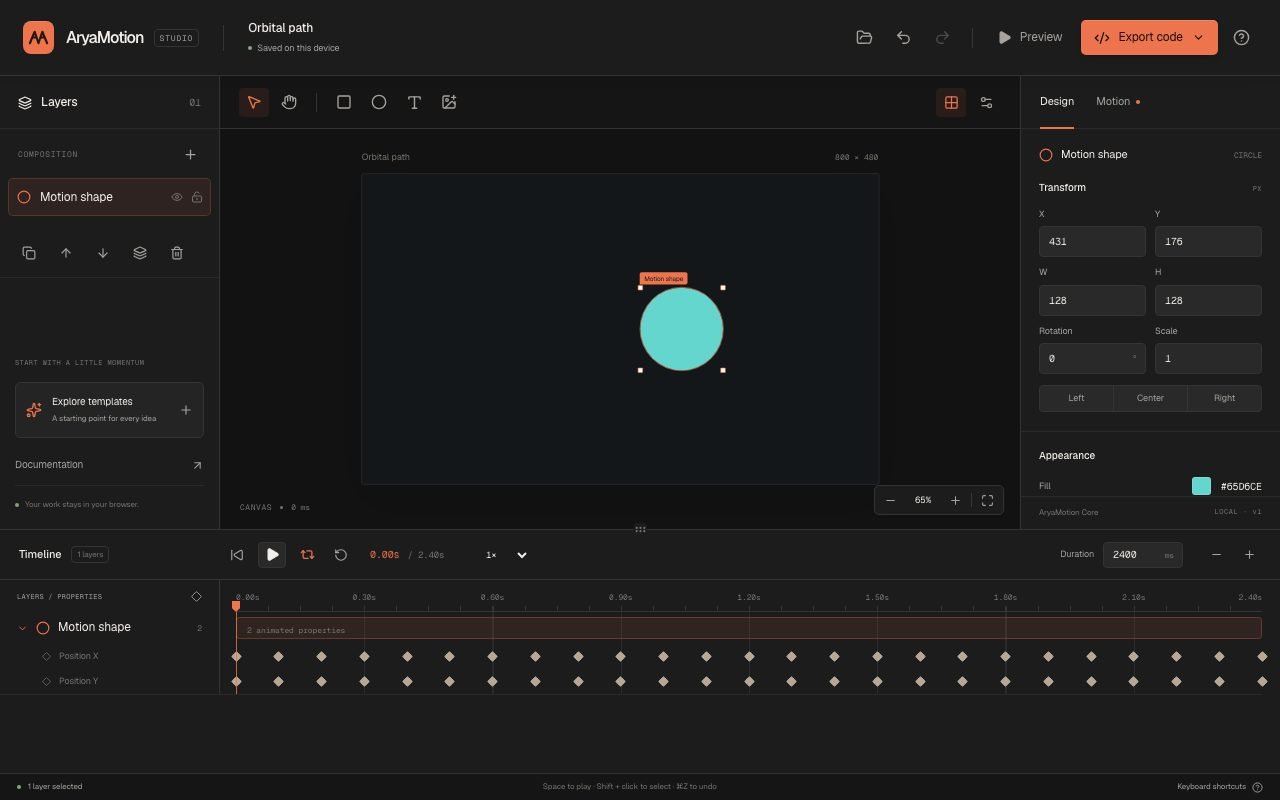
Project interface captures · design and implementation
Handwritten animation examples and a visual editor can drift apart when each uses a different model for timing, playback and export.
Use one versioned project document for layers, keyframes, preview and code generation. Keep the evaluator independent of React, compile track data before playback and move code generation into a worker.
A working browser-local studio with 40 editable studies, project persistence and six code export targets. The gallery, editor and exported animations share the same project model.
A recording of AryaMotion running in this portfolio. Follow the same composition from the gallery into the editor and through export.
Animation is a design decision and an engineering problem. AryaMotion brings both into one place: change a layer, shape its timing, and see the result immediately. The composition you edit is the same document the preview and exporters read.
Look insideA working animation studio with 40 editable studies, shared keyframe playback and exports for six web development targets.
The gallery, timeline and exported code need to express the same composition. Dense scenes must remain editable, and imported files must be treated as untrusted data.
Let the editor, previews and exporters read the same typed layers and keyframes, with schema validation at the import boundary.
The tradeoff The model deliberately limits supported values and assets instead of executing arbitrary imported code.
Sort tracks and prepare easing once, share preview scheduling, and mount detailed scenes near the viewport.
The tradeoff Compilation adds a preparation step when a composition changes, keeping repeated evaluation smaller.
Generate code in a cancellable worker and bound the highlighted preview while retaining the full downloadable source.
The tradeoff Worker-less browsers use a main-thread fallback. Large exports can still take time and are shown with a busy state.
The studio and examples run here in the browser. Counts are derived from the implemented preset and export registries. Project storage is local; cloud collaboration and a published npm package remain future work.
The current scope is keyframe composition. Arbitrary SVG morphing, a nested 3D scene editor and cloud collaboration are outside this release.
Shape the overshoot and settling of a spring.
Fifty-five particles move together through a shared wave.
Six editable letters arrive with their own timing and spring.
A small change to the curve can make the same movement feel calm, quick, or full of energy.
Drag either handle, or enter precise coordinates above. The horizontal controls stay between 0 and 1.
Four connected systems, with a versioned animation model at the center.
Timeline values use milliseconds. A timestamp-based clock drives playback, and seeking evaluates the document at a precise time.
Layer properties and animation tracks live together in a versioned document. Preview and code generation read the same values.
Interpolation, easing, spring physics, and keyframe evaluation live in TypeScript modules that work independently of React.
Public previews pause outside the viewport and respect reduced motion. Buttons, numeric fields, and scrubbers provide alternatives to dragging.
Projects stay in this browser. Export a project file to keep a backup or move your composition between devices. Cloud collaboration is a future capability.
CSS and Web Animations API exports target browser primitives. Framework exports use the repository engine. Export warnings call out effects that need special handling.
This release focuses on keyframe compositions. Arbitrary SVG path morphing, advanced asset pipelines, and a published npm package remain future work.
No account. Just a canvas and a little curiosity.